
In 2026, digital marketing will demand a holistic approach to connect with customers wherever they are. The landscape is shifting rapidly, shaped by AI-driven search, omnichannel experiences, and increasing customer expectations.
Businesses that want to stay ahead must embrace full stack digital marketing. This means mastering every stage of the online journey, from strategic planning to analytics, and adapting to new technologies.
This guide provides a comprehensive blueprint for building, executing, and optimising your strategy for the years ahead. Read on to discover essential frameworks, the latest tools, and proven tactics for measurable results.
What is Full Stack Digital Marketing?
Full stack digital marketing is an integrated approach that combines all digital marketing channels, technologies, and data sources to deliver a seamless and consistent customer experience. Instead of running isolated campaigns, businesses now unify efforts across SEO, content, paid media, social, email, automation, analytics, and emerging platforms. This coordinated strategy ensures every customer interaction is informed by data and aligned with broader business objectives.
The evolution of digital marketing has seen a shift from siloed tactics to an interconnected full stack digital marketing model. In the past, teams managed channels independently, often leading to fragmented messaging and duplicated efforts. Today, the focus is on breaking down these silos, enabling marketers to create holistic customer journeys that drive engagement and results. For a deeper dive into the methodology and trends shaping this evolution, see Digital marketing strategies and trends.
At the heart of full stack digital marketing are several core components:
- Search Engine Optimisation (SEO): Ensuring visibility on search platforms using AI-driven insights.
- Content Marketing: Creating valuable, personalised content across formats.
- Paid Media: Running omnichannel ad campaigns with data-led targeting.
- Social Media: Engaging communities and leveraging influencers.
- Email and Automation: Personalising communications and automating journeys.
- Analytics: Tying all efforts together with unified measurement and attribution.
- Emerging Channels: Exploring new touchpoints like voice search and AR/VR.
The benefits of full stack digital marketing are significant. Centralising data enables consistent messaging and better decision-making. Brands experience improved ROI, as integrated strategies allow for smarter budget allocation and rapid responses to market shifts. According to Wrike, companies using integrated approaches see 30% higher ROI compared to those with fragmented tactics.
However, there are challenges. The complexity of managing multiple platforms and tools can lead to technology overload. Skill gaps may emerge as teams adapt to the demands of a full stack digital marketing strategy. Navigating data privacy regulations and integrating legacy systems remain ongoing hurdles for many organisations.
Real-world examples highlight the power of full stack digital marketing. Leading brands have executed omnichannel campaigns that move users seamlessly from social media ads to personalised landing pages, followed by automated email nurturing—all tracked through unified data platforms. These approaches not only boost engagement but also create measurable outcomes across the customer lifecycle.
Looking ahead to 2026, full stack digital marketing will be shaped by advancements in AI, the increasing value of first-party data, and a heightened focus on privacy. Marketers will need to balance innovation with compliance, leveraging technology to anticipate customer needs while respecting user consent. Embracing a full stack digital marketing framework is essential for businesses aiming to stay competitive in a rapidly evolving landscape.
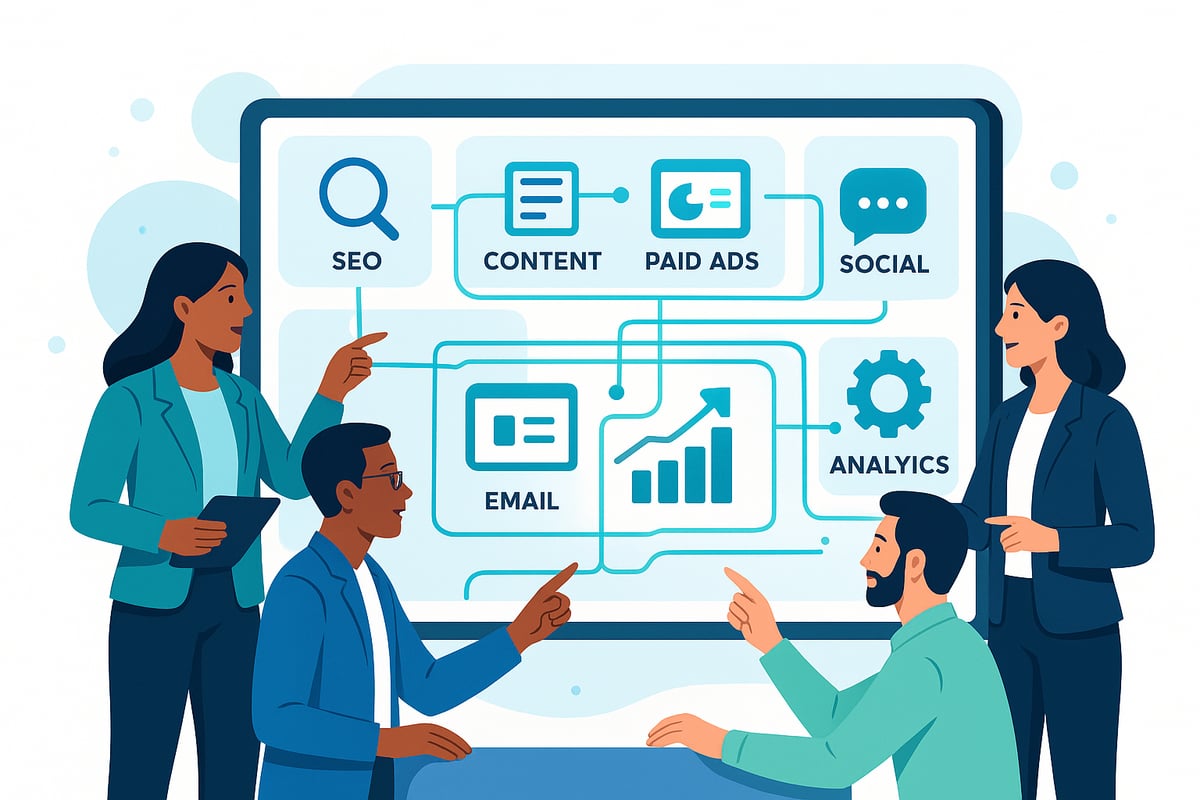
Core Components of a Full Stack Digital Marketing Strategy
To thrive in 2026, businesses must master every aspect of full stack digital marketing. This integrated approach brings together advanced tools, channels, and data, creating a seamless customer experience and driving measurable growth. Let us explore the six pillars that form the foundation of a future-ready full stack digital marketing strategy.
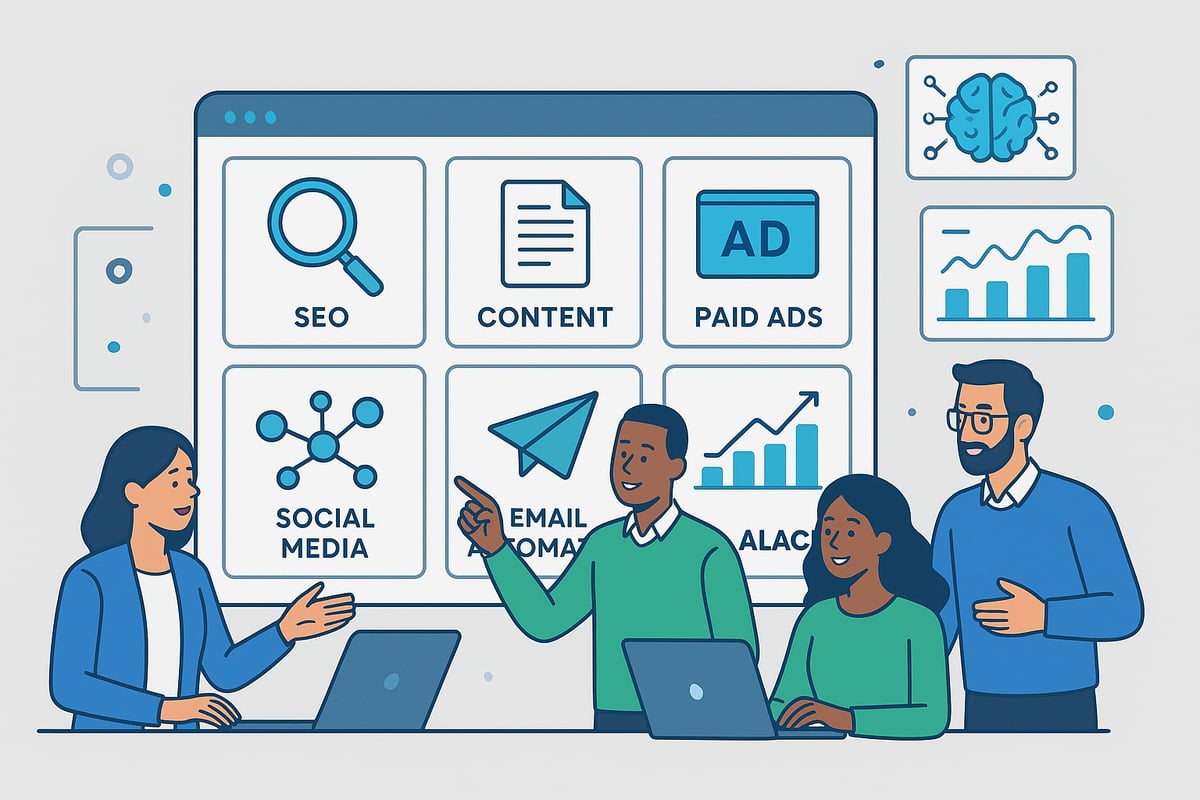
Search Engine Optimisation (SEO) in 2026
SEO in 2026 is driven by AI-powered search engines and Large Language Models, transforming how content is discovered and ranked. Brands need to demonstrate E-E-A-T—experience, expertise, authoritativeness, and trustworthiness—to earn visibility. Optimising for voice and visual search is crucial, as 70% of users now use voice search weekly (Wrike). Successful full stack digital marketing strategies prioritise structured data, conversational content, and accessibility. Leading brands optimise not only for Google but also Bing and emerging AI search assistants, ensuring they reach users wherever they search. Adapting to AI search means constant learning and agile content updates.
Content Marketing & Storytelling
Personalisation is at the heart of content marketing within a full stack digital marketing framework. AI enables real-time dynamic content, tailoring messages to individual preferences and behaviours. Video, interactive tools, and AR/VR experiences engage audiences at every stage. User-generated content and community storytelling foster trust and advocacy. Brands using AI-powered personalisation see campaigns that adapt on the fly, doubling engagement rates (Wrike). The full stack digital marketing approach ensures content is distributed across channels, aligned with the user journey, and measured for impact, keeping messaging both relevant and memorable.
Paid Media & Performance Marketing
Paid media is evolving rapidly within full stack digital marketing, with omnichannel campaigns spanning Google, Meta, TikTok, and programmatic platforms. AI-driven bidding and creative optimisation lower costs and boost ROI. Privacy-first targeting is essential in a post-cookie world, relying on first-party data and contextual signals. Cross-channel retargeting and sequential messaging improve customer acquisition and retention. Brands leveraging AI in paid media see a 20% reduction in CPA on average. Full stack digital marketing teams integrate paid with organic tactics, ensuring budget is allocated where it delivers the most value and measurable results.
Social Media & Community Engagement
The social landscape in full stack digital marketing demands platform diversification. Brands engage audiences on mainstream, niche, and emerging networks, adapting messaging to each environment. Influencer and micro-influencer partnerships enable authentic connections, while social commerce and shoppable content drive direct sales. With social commerce projected to exceed $150B globally by 2026, brands optimise for TikTok, Instagram Shopping, and new platforms. Full stack digital marketing teams build communities, foster engagement, and leverage data to refine their approach, ensuring every interaction strengthens brand loyalty and drives growth.
Email, Automation & CRM
Automation is fundamental to email marketing in full stack digital marketing strategies. Automated lifecycle journeys nurture leads, onboard new customers, and re-engage lapsed ones. Hyper-personalisation uses first-party data, ensuring every message is timely and relevant. Integrating email with CRM and Customer Data Platforms (CDPs) creates a unified view of each customer. Brands deploying automated campaigns see 320% more revenue than those relying on manual emails (Wrike). Full stack digital marketing teams continuously test, optimise, and align messaging across channels, maximising the impact of every interaction.
Data, Analytics & Attribution
Data is the backbone of full stack digital marketing, enabling real-time measurement and optimisation. Unified dashboards and advanced analytics provide a holistic view of performance across all channels. Multi-touch attribution models reveal the true impact of each tactic, while predictive analytics and AI-driven insights guide future strategy. Marketers using unified analytics are 23% more likely to hit their targets (Wrike). For guidance on selecting and integrating the right platforms, explore these digital marketing tools and automation solutions. A strong data foundation empowers teams to connect spend with outcomes and scale what works.
Step-by-Step: Building a Full Stack Digital Marketing Strategy for 2026
Crafting a robust full stack digital marketing strategy for 2026 requires a clear roadmap. Each step lays the foundation for measurable growth, adaptability, and customer-centric outcomes.
To help you visualise this process, here is a high-level overview:
| Step | Focus Area | Key Outcome |
|---|---|---|
| 1 | Audit & Align Business Objectives | Strategic alignment |
| 2 | Audience Research & Persona Development | Deep customer understanding |
| 3 | Channel Selection & Tactical Planning | Effective channel mix |
| 4 | Content & Campaign Development | Engaging, relevant campaigns |
| 5 | Technology Stack & Integration | Seamless tech ecosystem |
| 6 | Launch, Test & Optimise | Data-driven improvements |
| 7 | Measure, Report & Scale | Sustainable growth |
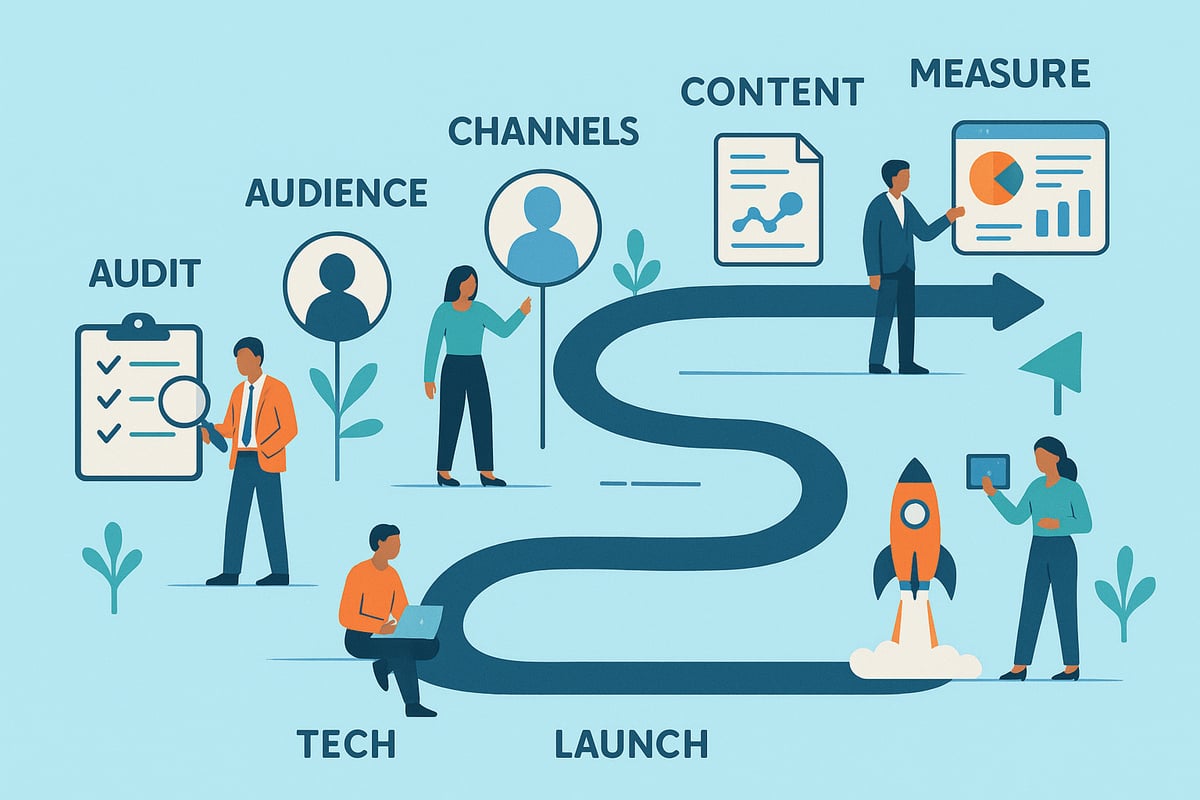
Step 1: Audit & Align Business Objectives
Start your full stack digital marketing journey by evaluating your current digital presence. Audit website performance, social media profiles, ad campaigns, and analytics. Identify strengths, weaknesses, opportunities, and threats using a SWOT analysis.
Next, align business goals with digital marketing KPIs. Ensure stakeholders agree on what success looks like. For a detailed approach to mapping objectives and KPIs, see Strategic digital marketing planning.
This foundation ensures your full stack digital marketing strategy is targeted and measurable.
Step 2: Audience Research & Persona Development
Understanding your audience is essential for full stack digital marketing success. Gather first-party and zero-party data from website interactions, CRM, and surveys. Use AI tools to reveal behavioural patterns and segment users.
Develop dynamic personas based on real customer journeys, not just static demographics. Map these personas to different touchpoints across your marketing funnel.
This step lets you personalise messaging and anticipate customer needs, increasing engagement and loyalty.
Step 3: Channel Selection & Tactical Planning
Select the optimal mix of owned, earned, and paid channels for your full stack digital marketing approach. Analyse where your audience spends time, and prioritise platforms that align with your business objectives.
Include emerging channels like AI-powered search and new social networks. Balance investments across SEO, paid search, influencer partnerships, and programmatic ads.
A tactical channel plan ensures resources are focused on areas with the highest return.
Step 4: Content & Campaign Development
Develop a content calendar tailored to each stage of the buyer’s journey. Use automation to distribute content efficiently across all chosen channels within your full stack digital marketing ecosystem.
Incorporate formats like video, interactive experiences, and shoppable posts to boost engagement. Plan cross-channel campaigns that tell a cohesive story, moving users seamlessly from awareness to conversion.
Well-developed content and campaigns are the engine of your marketing strategy.
Step 5: Technology Stack & Integration
Choose marketing platforms that integrate smoothly, such as CRM, CMS, automation, and analytics tools. Prioritise solutions that support data privacy and compliance with GDPR, CCPA, and Australian Privacy Principles.
Connect tools like Google Analytics 4, HubSpot, and programmatic ad platforms to create a unified data environment. This integration is vital for full stack digital marketing, enabling real-time insights and efficient workflows.
A strong tech stack supports agility and informed decision-making.
Step 6: Launch, Test & Optimise
With your full stack digital marketing campaigns ready, launch and monitor performance closely. Set up A/B and multivariate tests to compare messaging, creative, and landing pages.
Use real-time analytics to adapt campaigns quickly. Agile optimisation ensures you capture opportunities and address underperformance as soon as data becomes available.
Continuous testing leads to smarter investments and better outcomes.
Step 7: Measure, Report & Scale
Track your KPIs and ROI consistently. Build executive dashboards that display results for all stakeholders, making it easy to communicate wins and identify areas for improvement.
Scale successful strategies, and sunset those that underperform. Schedule quarterly business reviews and optimisation sprints to keep your full stack digital marketing efforts future-ready.
This final step ensures your strategy evolves with business needs and market trends.
Essential Skills & Team Structure for Full Stack Digital Marketing
Building a high-performing team is crucial for success in full stack digital marketing. The blend of technical, creative, and strategic skills ensures campaigns are integrated and adaptable for 2026.
A balanced skills matrix is the foundation. Teams must combine expertise in SEO, analytics, content creation, design, and leadership. The table below outlines these core skill areas:
| Technical | Creative | Strategic |
|---|---|---|
| SEO | Content Writing | Campaign Planning |
| Data Analytics | Visual Design | Team Leadership |
| Automation Tools | Video Production | Brand Strategy |
Roles within a full stack digital marketing team include full stack marketers who oversee the entire customer journey, channel specialists for SEO or paid media, data analysts for insights, and automation experts. Marketers with three or more distinct skills are 40% more effective, according to Wrike.
Collaboration is streamlined through cross-functional teams and agile workflows. These structures allow teams to respond rapidly to trends and optimise campaigns in real time. Continuous upskilling is essential, especially as AI, automation, and privacy regulations evolve. Regular training sessions and access to industry resources keep skills current.
Team structure will vary by business size. For example:
| Team Structure | SMBs | Enterprise |
|---|---|---|
| Core Roles | Generalists, 1-2 specialists | Channel, data, automation specialists |
| Collaboration Style | Direct, flexible | Formal, agile pods |
| Upskilling Approach | On-the-job, online courses | Structured training, workshops |
Remote and hybrid team models are now standard. Best practices include clear communication channels, defined responsibilities, and regular check-ins to maintain productivity and engagement.
Addressing skill gaps is a challenge for many businesses. Partnering with a local agency can provide immediate access to full stack digital marketing expertise, advanced tools, and proven frameworks. For more on when to consider external support, see these local digital marketing agency insights.
Developing a robust full stack digital marketing team is a strategic investment. By fostering diverse skills, encouraging collaboration, and leveraging agency partnerships, organisations can position themselves for measurable growth and competitive advantage in 2026.
Future Trends & Innovations in Full Stack Digital Marketing
The future of full stack digital marketing is being reshaped by rapid technological advancement and changing consumer expectations. As we look towards 2026, marketers must stay agile and adopt a forward-thinking mindset to remain competitive. The landscape is evolving quickly, with new frameworks, platforms, and privacy requirements emerging each year.
AI & Automation: The Heartbeat of Campaign Optimisation
AI and automation are at the core of full stack digital marketing innovation. Predictive analytics now drive smarter audience segmentation and campaign timing. Marketers leverage AI-powered chatbots for instant customer support, while generative content tools streamline asset creation for every channel.
With 80% of marketing leaders expected to use AI for campaign optimisation by 2026 (Gartner), brands can anticipate market shifts and personalise experiences at scale. Automation also ensures consistency and frees up teams to focus on strategy and creative execution.
Privacy, Data and Consent: Building Trust in a Digital World
As privacy regulations tighten, first-party data strategies have become essential in full stack digital marketing. Consent management tools and data clean rooms help organisations balance compliance with customisation. Brands are moving away from third-party cookies, prioritising transparency and ethical data use.
Customer Data Platforms (CDPs) unify interactions across touchpoints, allowing marketers to deliver relevant content while respecting user privacy. This evolution is crucial for maintaining trust and achieving long-term loyalty.
Omnichannel Experience & Search Evolution
Delivering a seamless omnichannel experience is fundamental for full stack digital marketing success. Integration across web, mobile, voice assistants, and IoT devices ensures brand consistency and meets users wherever they are. AI-driven search engines and zero-click results are transforming how consumers discover information.
Optimising for voice and visual search, as well as emerging AI assistants, keeps brands visible in a fragmented digital ecosystem. Marketers must embrace these channels to drive conversions and retain a competitive edge.
Social, Community & Commerce: The New Digital Marketplace
Social platforms are evolving into immersive marketplaces, blurring the line between content and commerce. Private communities and decentralised platforms are gaining traction, enabling brands to foster deeper engagement and loyalty.
The rise of TikTok Shop and similar innovations is accelerating social commerce, a trend explored in Digital Marketing Trends 2026. Full stack digital marketing strategies must adapt to these shifts, leveraging influencer partnerships, shoppable content, and community-driven campaigns to drive sales and advocacy.
Interactive, Immersive & Sustainable Marketing
Interactive content, AR/VR experiences, and gamification are redefining user engagement. Live streaming and real-time participation build authentic connections, while immersive storytelling captures attention in crowded feeds.
Sustainability and ethics are also moving to the forefront. Green marketing initiatives and responsible data use reflect shifting consumer values. Brands that prioritise environmental responsibility and transparent practices will stand out in a purpose-driven marketplace.
Example: Brands Leading the Way
Forward-thinking brands are harnessing AI for hyper-personalisation and real-time engagement, using unified data to inform every touchpoint. For more on how cross-platform coordination and personalisation drive results, see Full-Stack Marketing Strategies.
In summary, the next era of full stack digital marketing will be defined by innovation, integration, and integrity. Staying ahead requires embracing new technologies, prioritising privacy, and delivering meaningful experiences across every channel.
As you’ve seen throughout this guide, mastering full stack digital marketing is crucial for staying competitive in 2026—whether it’s leveraging AI, integrating your channels, or building seamless customer experiences. If you’re ready to take your business to the next level but aren’t sure where to start, you don’t have to do it alone. At My Heart Studio, we’re passionate about helping Australian businesses build strategies that actually deliver results. Let’s chat about your goals and how you can put these strategies into action—simply Book a Free Strategy Call today.